
Pop-up display, fabric or LED exhibition wall? Set-up, look, transport, costs and use compared honestly – with help to decide.
In short
Pop-up stands are the quickest to set up, fabric exhibition walls look calmer with their smooth, seamless fabric surface, and LED exhibition walls stand out most thanks to their backlit surface – for which they need a power connection. Our fabric and LED exhibition walls are delivered ready printed, with print included in the price: fabric exhibition walls from €1,188.51, LED Exhibition Walls XL from €1,367.49, each incl. VAT.
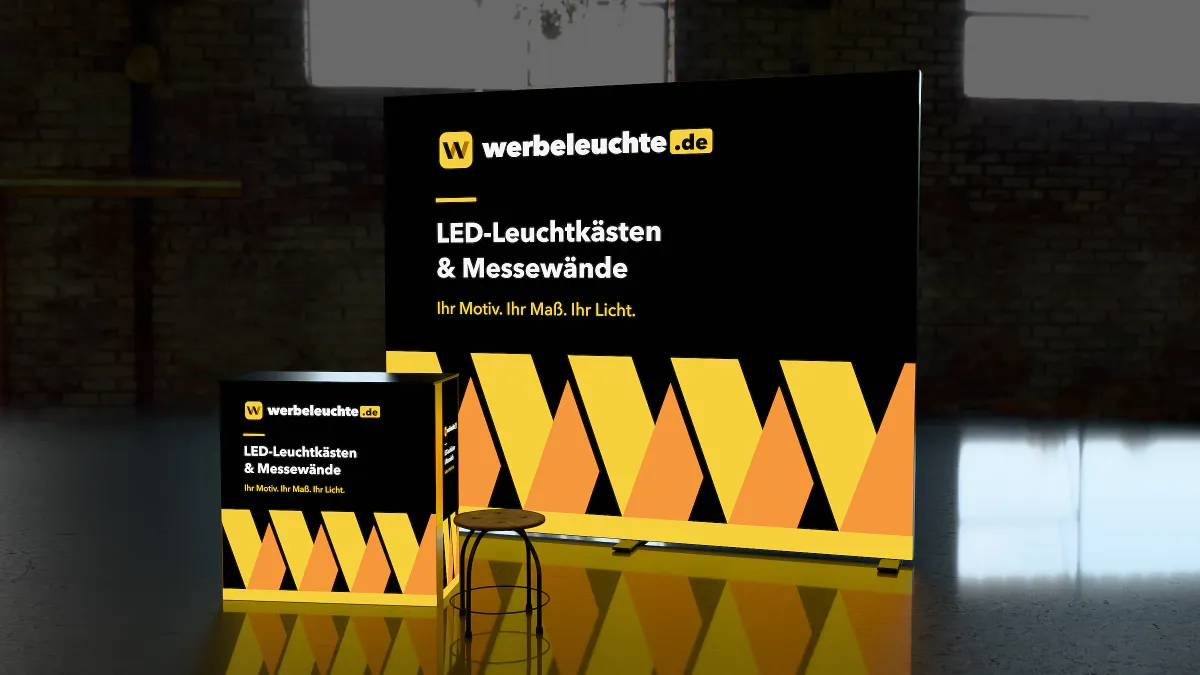
There are three common solutions for the backwall of an exhibition stand: the classic pop-up display (also called a pop-up stand or folding display), the plug-in fabric exhibition wall and the illuminated LED exhibition wall. All three have their merits. This comparison helps you find the right solution for your presence – without any sugar-coating.
The three systems at a glance
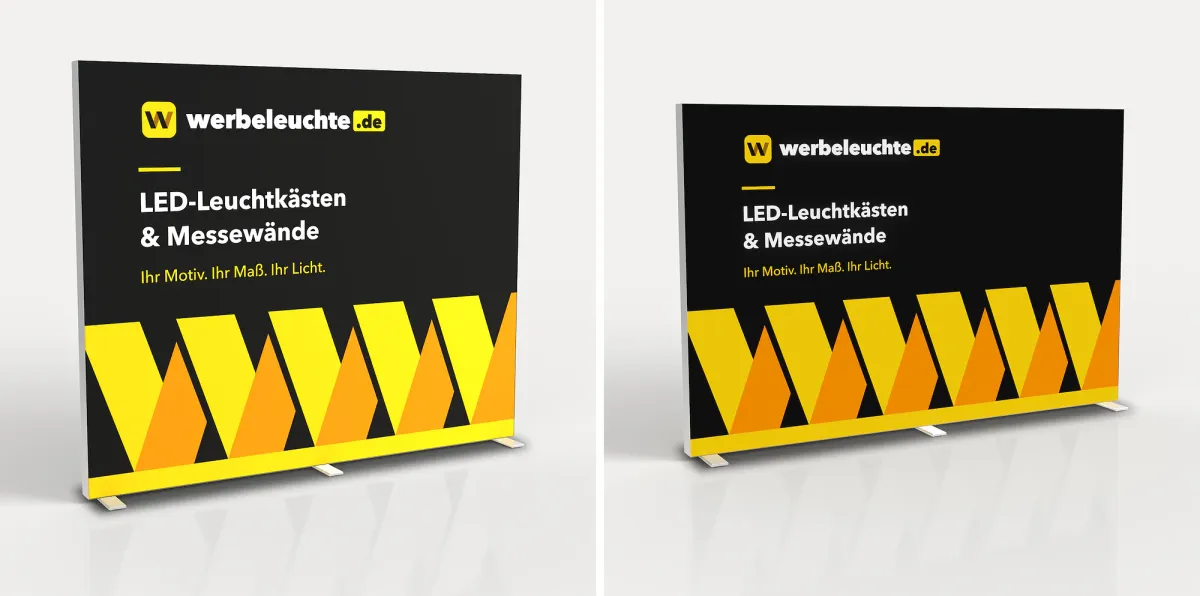
Pop-up display
A scissor frame that pulls open like a lattice. Printed panels or a continuous fabric are attached to it, often with magnetic strips. Pop-up displays are available in many versions and are known above all for their quick set-up.
Fabric exhibition wall
A frame of plug-in profiles into which a printed fabric with a keder all round is inserted. The Fabric Exhibition Wall XL, for example, is available in widths from 100 to 500 cm and heights from 200 to 298 cm.
LED exhibition wall
Constructed like the fabric exhibition wall, but with integrated LED modules in the profile. The fabric is lit from behind and glows evenly. Examples: the LED Exhibition Wall XL (175 to 500 cm wide), the LED Exhibition Wall XXL (up to 10 m) and the LED Exhibition Walls Pro with black profile.
Comparison by criteria
Look and impact
- Pop-up display: depending on the version, panel joints or magnetic strips are visible. With continuous fabric it looks calmer, but the surface can ripple more easily.
- Fabric exhibition wall: a continuously smooth, tightly tensioned surface without visible joints.
- LED exhibition wall: a smooth surface that glows by itself. In bright exhibition halls it stands out clearly from its surroundings – the biggest difference in perception.
Assembly
- Pop-up display: very fast – the frame is pulled open and the graphic hung on.
- Fabric and LED exhibition wall: profiles are plugged together and joined with thumb screws, then the fabric is inserted. This takes a little longer than with a pop-up display but needs no tools. The LED wall also requires a power connection.
Stability and durability
- Pop-up display: hinges and scissor frames are moving parts that may show wear with frequent use.
- Fabric and LED exhibition wall: rigid profile frames without scissor mechanism; spare parts such as connectors, feet or LED modules are available individually.
Artwork changes
- Pop-up display: depending on the system, panels or a fabric banner are replaced.
- Fabric and LED exhibition walls: the fabric is pulled out by its keder and replaced with a new one. The first print is already included in the purchase price; each new fabric print costs €40 net per square metre and side.
Transport
- Pop-up display: collapses compactly, usually into a bag or case.
- Fabric and LED exhibition wall: dismantled in an ABS transport case with wheels and handle, which is included with our exhibition walls.
Expandability
- Pop-up display: fixed sizes; expansion usually only with a second system.
- Fabric and LED exhibition wall: modular. With the Extension module LED Exhibition Wall XL and system connectors for corners and T-connections, the wall grows with the stand.
Power
- Pop-up display and fabric exhibition wall: no power needed (except for separate spotlights).
- LED exhibition wall: requires a power connection. The power consumption is stated for every product – for the LED Exhibition Wall XL at 200 cm height, for example, 280 W at 300 cm width.
Table: pop-up display, fabric and LED exhibition wall
| Criterion | Pop-up display | Fabric exhibition wall | LED exhibition wall |
|---|---|---|---|
| Impact in a bright hall | good | good | very eye-catching (self-illuminating) |
| Surface | possibly joints/magnetic strips | smooth | smooth, illuminated |
| Assembly | very fast | quick, no tools | quick, no tools + power |
| Expandable | limited | modular | modular |
| Power required | no | no | yes |
| Price | usually the cheapest | medium | higher |
What does each solution cost?
There is a very wide range of pop-up stands, from simple entry-level models to high-end versions, and prices vary accordingly. Our exhibition walls, by contrast, are always delivered ready printed – the artwork print (€40 net per square metre and side) is already included in the price shown. You will find current prices for each size on the product pages:
Which solution suits you?
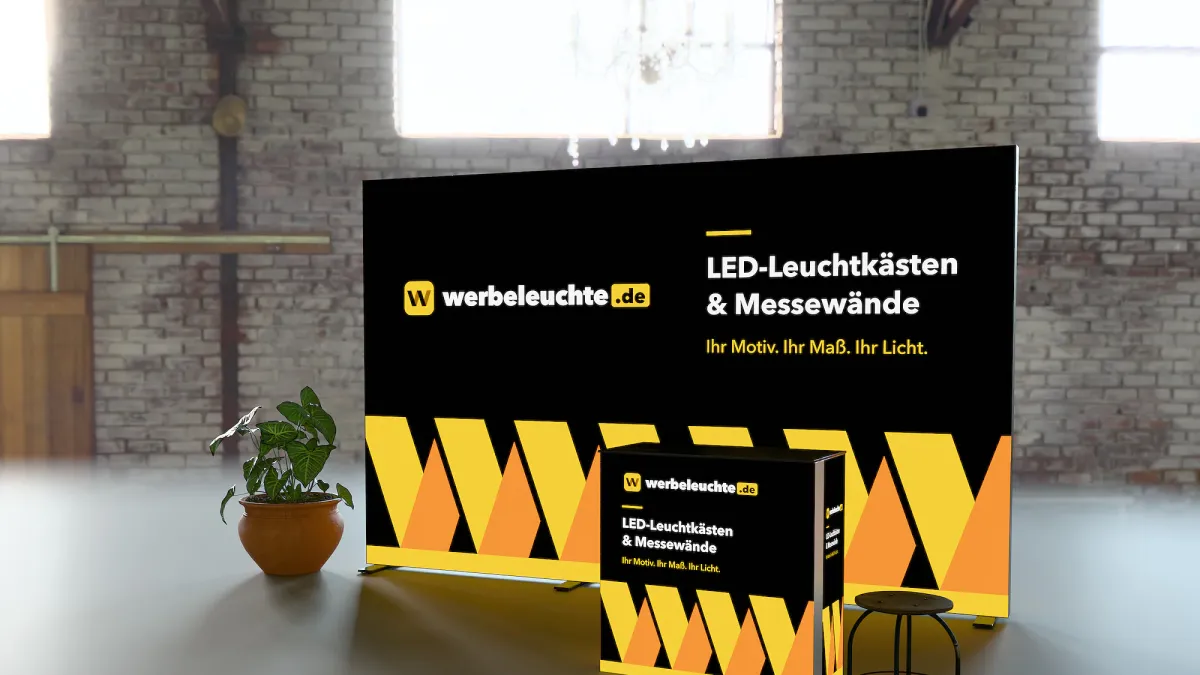
Pop-up display if …
- you rarely exhibit and are looking for the most affordable solution,
- set-up has to be extremely fast,
- looks and expandability are secondary.
Fabric exhibition wall if …
- you want a smooth, premium surface without joints,
- the hall is well lit or no power connection is available,
- you are looking for a sturdy, modular system that grows.
LED exhibition wall if …
- your stand needs to stand out in a bright hall with many neighbours,
- you exhibit regularly and want to make an impact,
- your brand and message should be visible from a distance.
A good compromise: the backwall as an LED exhibition wall, the side walls as fabric exhibition walls. This way the main surface glows while the secondary surfaces remain more affordable – both systems use the same profile principle and match visually.
Checklist before buying
- Exhibition guidelines: what wall height is permitted? It is often 250 cm – our exhibition walls are available in 248 cm height.
- Stand size: does the wall width match the backwall, and do you need side walls?
- Power: is a power connection planned for the stand? It is required for LED walls.
- Frequency: how often will the wall be set up? With frequent use, a sturdy profile system pays off.
- Artwork changes: how often do campaigns change? An interchangeable fabric print then saves costs.
- Transport: who transports the wall, and how much space is there in the vehicle?