
Outdoor illuminated signs: when a permit may be required, how to calculate electricity costs, what IP protection means – and the shop-window alternative.
In short
Whether illuminated signage on a façade needs planning permission depends on the local authority, size and location – check with your planning office first. Calculate electricity costs as power in kW × hours × days × electricity price: a 59 W light wall running ten hours a day uses around 17.7 kWh a month. Our illuminated systems (IP20) are built for indoor use and work behind the shop window; the Digital A-Board Outdoor is weatherproof to IP65.
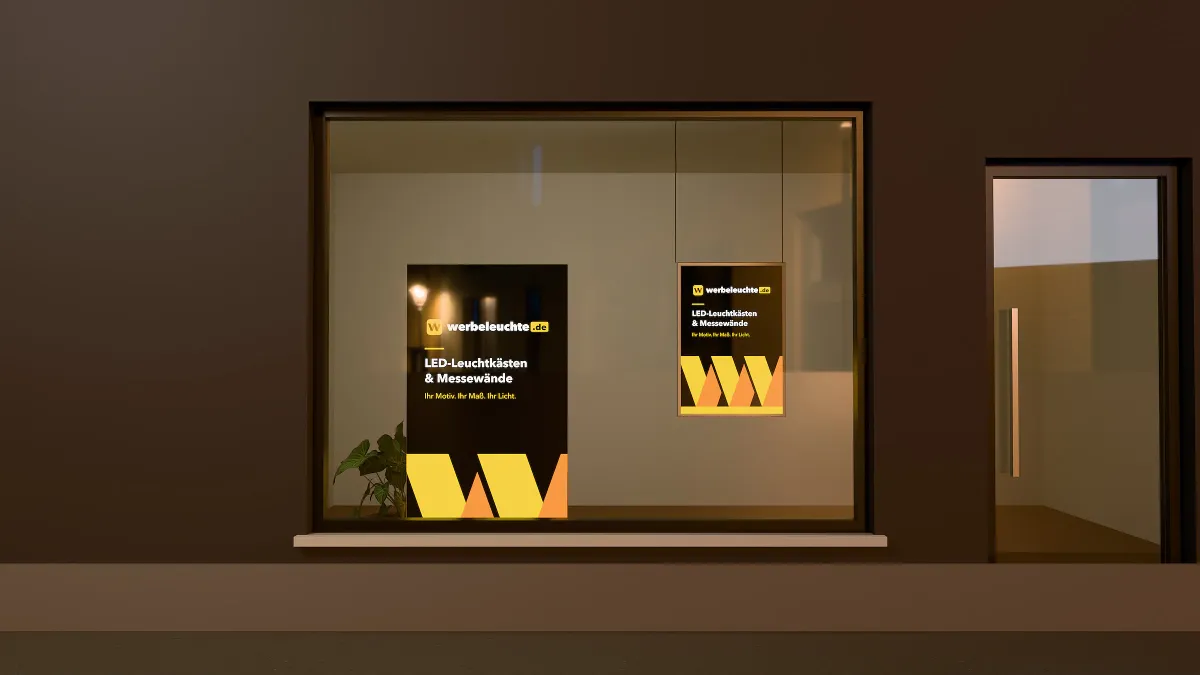
An illuminated sign makes your business visible even after closing time. Before you screw a sign to the façade, however, three questions arise: Do I need a permit? What does it cost to run per year? And how long will the technology last outdoors in rain, frost and sun? This guide gives you an overview – and explains honestly when a solution behind the shop window is the better choice.
Note: This guide does not replace legal advice. The regulations differ from one federal state and municipality to another. The building authority of your town or municipality can give you binding information.
What types of illuminated sign are there?
Lightbox on the façade
A flat box with a backlit graphic, usually above the entrance or as a projecting sign at right angles to the façade. For outdoor use it needs a weatherproof housing, sealed cable entries and a permanently installed power supply.
Illuminated letters
Individual, self-illuminated letters or logos. They look high-end but are complex to manufacture and install.
Illuminated advertising in the shop window
A lightbox, a light wall or a particularly bright screen stands inside, directly behind the glass, and is seen from outside. Technology and print remain protected from the weather.
Mobile displays outside the door
A-boards and displays that stand on the pavement during the day and are brought in at night – classic, illuminated or digital.
Permits: what to clarify beforehand
In Germany, advertising installations are mainly regulated by the building codes of the federal states. Whether an illuminated sign requires a permit depends, among other things, on the size, location and type of installation. Local regulations may also apply. So before ordering, clarify the following:
- Ask the building authority: Ask your town or municipality whether a permit or notification is required for your planned installation and which documents are needed.
- Local bylaws: Many municipalities have design or advertising bylaws, for example for town centres or historic old towns. They may regulate size, colour, position or the type of lighting.
- Listed buildings: Additional requirements often apply on or near listed buildings.
- Road traffic: Illuminated advertising must not dazzle road users or be mistaken for traffic signs. For installations near roads, the road traffic authority may be involved.
- Public space: If a sign projects over the pavement or a display stands on public land, a special use permit may be required.
- Owner and tenancy agreement: As a tenant, you usually need the owner's consent for mounting and for a power connection on the façade.
- Neighbours: Bright light at night can disturb neighbours. Ask whether there are rules on brightness or operating hours.
Allow time for this coordination and only order once size and position have been finalised.
Electricity costs: how to calculate them yourself
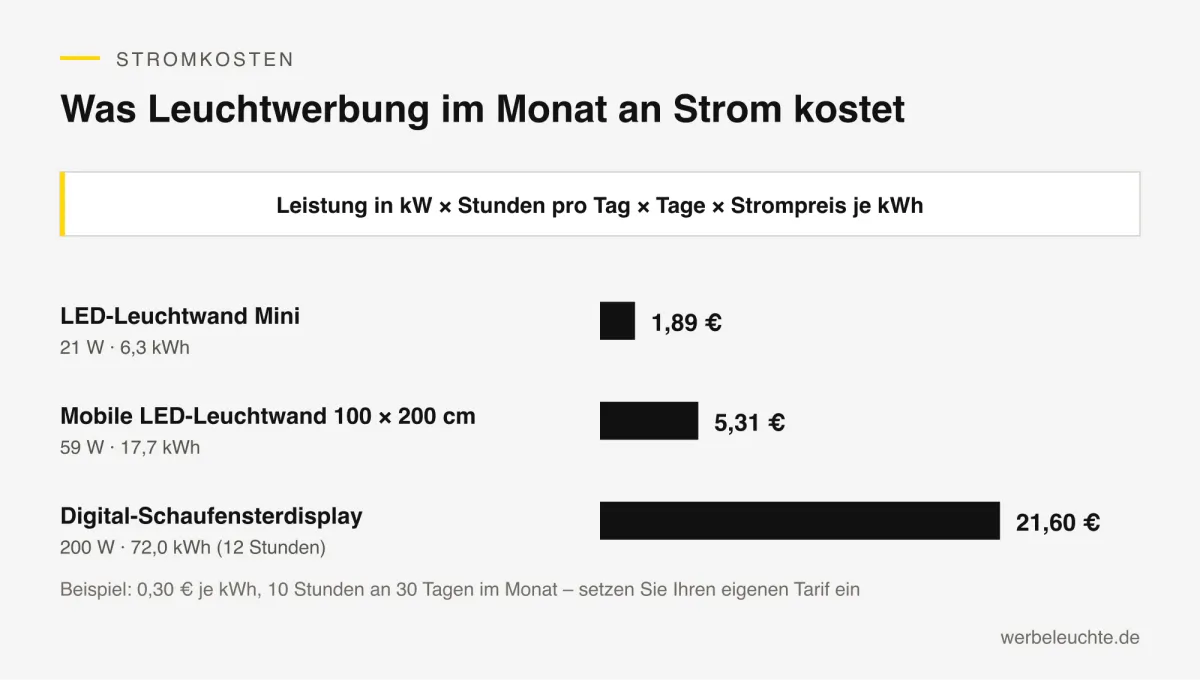
LED technology is economical, but not free. Electricity costs are easy to calculate:
Electricity costs per year = power in kW × operating hours per day × days × electricity price per kWh
The power consumption is listed for each of our products. An example with an assumed electricity price of €0.30 per kWh (insert your own tariff) and ten operating hours on 30 days a month:
| Product | Performance | kWh per month | Cost per month (example) |
|---|---|---|---|
| LED Light Wall Mini 50 × 150 cm | 21 W | 6.3 kWh | €1.89 |
| Portable LED Light Wall Classic 100 × 200 cm | 59 W | 17.7 kWh | €5.31 |
| Digital Window Display 55 inch (12 hours) | 200 W | 72.0 kWh | €21.60 |
Three levers reduce the costs:
- Timer: The sign only lights up when passers-by are around, not all night.
- The right size: A smaller, well-placed surface is often just as effective as a large one.
- Brightness on screens: Devices with a brightness sensor adjust their luminosity to the ambient light.
Durability: what matters outdoors
The protection class (IP code)
The protection class indicates how well a device is protected against foreign objects and water. Two examples for reference:
- IP20: protection against contact with fingers, but no protection against water – for indoor use only.
- IP65: dust-tight and protected against water jets – for outdoor use.
For an outdoor illuminated sign, you need a device that is expressly designed for outdoor use.
Weather and temperature
Outdoors, rain, frost, heat, wind and UV light act on the housing, seals and print. Pay attention to the permitted temperature range, secure fixing that can also withstand wind load, and a professional electrical installation. Work on the mains supply should be carried out by a qualified electrician.
Lifespan
How long an installation lasts depends on its design, location and maintenance. When buying an outdoor installation, ask specifically for the manufacturer's information on LED lifespan, warranty and spare parts – and get it in writing.
Honestly: what we offer – and what we don't
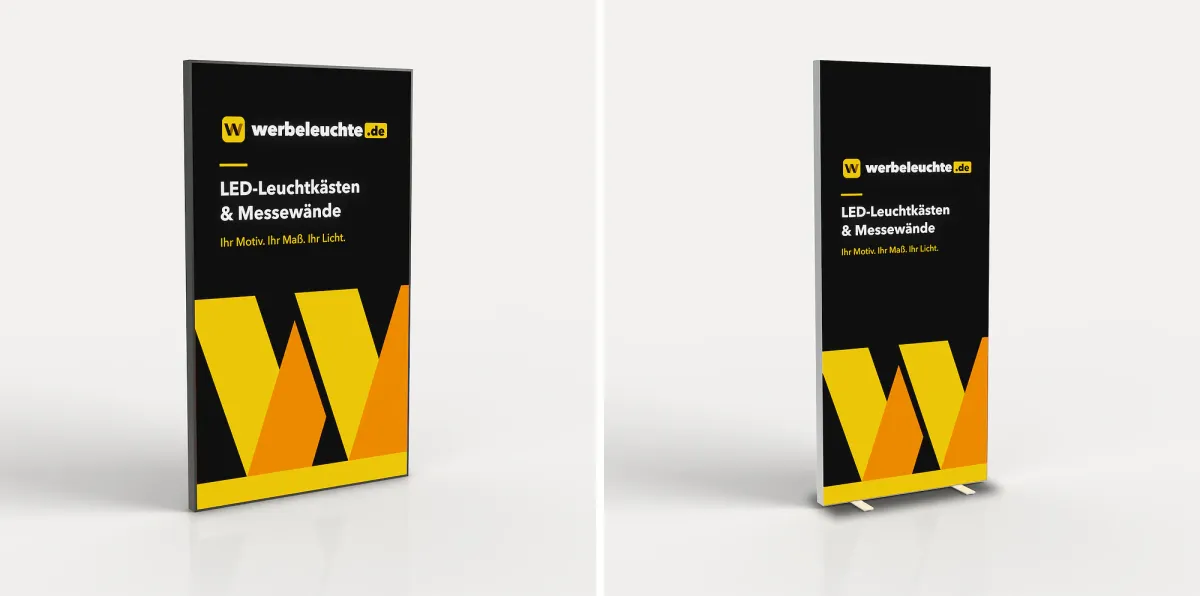
Our LED lightboxes, light walls and exhibition systems are built for indoor use. The light systems are rated at protection class IP20; they are not designed for permanent mounting on a façade. If you need a permanent illuminated sign on the outside of a building, a specialist illuminated signage company is the right contact.
Which indoor shop signage we supply – with dimensions, live prices and electricity costs – is shown on the page Shop Signage Made to Measure.
What we can offer you for visibility from outside:
1. Lightbox in the shop window
A Made-to-Measure LED Lightbox hangs inside behind the glass and shines outwards – made to the centimetre for your window, in widths and heights from 30 to 300 cm. Choose the size in the configurator and see the price including artwork print instantly. With the 160 mm profile the box is illuminated and printable on both sides: outside for passers-by, inside for your customers. You will find suspension kits for ceiling mounting under Accessories.
2. Light wall behind the window
A Portable LED Light Wall Classic stands freely in the window without installation and can be restyled with new artwork at any time – it is delivered ready printed with your artwork.
3. Digital shop window
The Digital Window Display 55 inch with 55 inches and 2,000 nits of brightness remains legible behind the glass even in daylight. You change content via USB stick, smartphone or content management system – from €4,751.08 incl. VAT.
4. Digital A-board for outdoors
The Digital A-Board Outdoor 43 inch is weatherproof to IP65, designed for –20 to +50 °C and runs on its battery for around 15 hours without a power cable. In the evening you wheel it inside and charge it. Read more in our guide Pavement signs: digital, illuminated or classic A-boards?.
| Solution | Location | Power | Façade permit |
|---|---|---|---|
| Illuminated sign on the façade | outdoors, permanently mounted | Hard-wired connection | often needs checking |
| Lightbox in the shop window | indoors, visible from outside | Socket | check local bylaws |
| Digital Window Display | indoors, visible from outside | Socket | check local bylaws |
| Digital A-Board Outdoor | Pavement, mobile | Battery | special use of public land may be required |
Local bylaws may also apply to advertising in shop windows – for example in historic town centres. A quick enquiry with the municipality gives you certainty.
Checklist before ordering
- Location decided: façade, shop window or pavement?
- Building authority or municipality consulted about permits and bylaws
- Consent obtained from owner or landlord
- Power connection clarified – hard-wired by a qualified electrician, socket or battery
- Protection class suited to the location (outdoors, only expressly weatherproof devices)
- Operating hours and timer planned
- Graphic designed for long-distance impact and artwork files checked
Planning tips for any illuminated advertising
- Check the line of sight: Stand on the opposite side of the street. Where do passers-by look? Eye level is often more effective than right at the top.
- Little text: Logo, one sentence, perhaps a web address. Nobody reads paragraphs from a distance.
- Contrast: Bright, strong graphics glow the most on a backlit print.
- Changing artwork: with fabric-print lightboxes you only swap the fabric – the first print is included in the price, and each new one costs €40 net per square metre and side.
- Artwork files: Our guide Artwork for fabric printing: bleed, resolution, colour explains how to set up bleed and resolution correctly.